Cacti are extraordinary plants, renowned for their striking forms and remarkable ability to thrive in some of the planet’s harshest environments. Far more than just spiky decorations, each cactus is a masterclass in biological engineering, with every component meticulously adapted for survival. Understanding the anatomy of these desert dwellers reveals a complex interplay of structures designed to conserve water, deter predators, and ensure propagation in arid landscapes. From their specialized root systems that greedily absorb sparse rainfall to their formidable spines and vibrant flowers, we will embark on a journey to explore the distinct parts of a cactus, uncovering the fascinating science behind their resilience and unique beauty.
Roots: The anchor and absorber
Beneath the soil, a cactus deploys a sophisticated root system, critically designed for immediate and efficient water uptake – a paramount concern in its typically arid habitat. Cacti generally exhibit two primary types of roots, each serving distinct but complementary roles. Many species develop extensive, shallow fibrous roots that spread out horizontally, often just a few inches below the surface. This architecture allows them to rapidly absorb even light rainfall or dew before it evaporates, maximizing the capture of precious moisture.
Conversely, some cacti, particularly larger columnar varieties, also feature a robust taproot system. These deeper roots serve a dual purpose: providing sturdy anchorage against winds and potentially reaching more stable, deeper water sources during prolonged dry spells. Beyond mere absorption, roots also facilitate the uptake of essential nutrients from the soil. In some specialized cases, like certain epiphytic cacti that grow on trees rather than in soil, adventitious roots may develop to cling to surfaces or absorb atmospheric moisture. The rapid responsiveness of cactus roots to moisture is a hallmark of their adaptation, enabling them to swell and quickly draw in water after a rain event, then often shrinking back to minimize water loss when the soil dries.
Stems: The succulent core
The stem is arguably the most recognizable and vital part of a cactus, serving as its primary water reservoir and photosynthetic engine. Unlike most plants where leaves perform photosynthesis, cactus stems have evolved to take on this crucial role, allowing them to minimize surface area and thus water loss. These stems come in a dazzling array of shapes – from globular and barrel-like forms that offer a low surface-area-to-volume ratio for maximum water retention, to tall columnar structures and flattened pads known as cladodes.
The outer layer, or epidermis, of a cactus stem is typically covered with a thick, waxy cuticle that significantly reduces transpiration. Hidden within the epidermis are specialized pores called stomata, which open primarily at night to take in carbon dioxide through a process known as Crassulacean Acid Metabolism (CAM) photosynthesis. This nocturnal gas exchange dramatically reduces water loss that would occur if stomata were open during the scorching desert day. Internally, the stem is largely composed of parenchyma tissue, a spongy cellular network capable of expanding significantly to store vast quantities of water, allowing the cactus to endure extended periods of drought. Many stems feature distinctive ribs or tubercles, which not only provide structural support but also help channel rainwater down to the roots and offer some degree of self-shading.
Areoles and spines: Evolutionary marvels
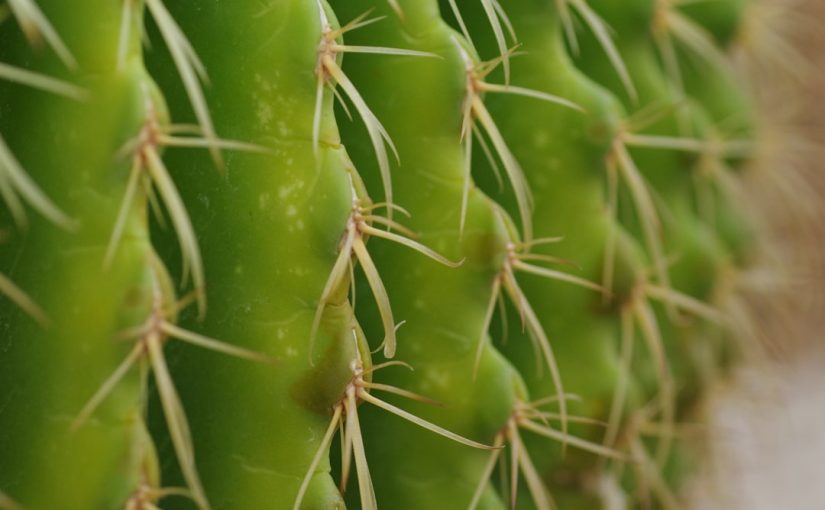
A defining characteristic unique to the cactus family is the presence of areoles. These small, cushion-like structures, typically appearing as fuzzy or woolly spots along the ribs or tubercles of the stem, are actually highly modified branches. Far from being merely decorative, areoles are central to cactus biology. They are the growth centers from which spines, flowers, and new branches (offsets) emerge, distinguishing cacti from other succulent plants.
Emerging from these areoles are the famed spines, which are modified leaves. Their primary function is multifaceted and critical for survival. Foremost, they provide a formidable defense mechanism against herbivores seeking to access the cactus’s precious water-filled tissues. Beyond protection, spines play a role in microclimate regulation. They can help shade the stem from intense solar radiation, reducing the surface temperature and thereby minimizing water loss. In some cases, spines also facilitate the condensation of atmospheric moisture, directing dew or fog droplets down to the plant’s base where roots can absorb them. The diversity of spines is remarkable, ranging from fine, hair-like structures to stout, needle-sharp barbs. A particularly irritating type, found in Opuntia species, are glochids – tiny, barbed bristles that detach easily and are notoriously difficult to remove from skin. Some species even have woolly hairs emanating from their areoles, providing additional insulation against extreme temperatures.
| Function | Description | Example cactus feature |
|---|---|---|
| Protection | Deters herbivores from consuming succulent tissues. | Long, sharp, robust spines |
| Shading | Reduces direct sun exposure on the stem, lowering surface temperature. | Dense network of fine or coarse spines |
| Water collection | Condenses atmospheric moisture (dew, fog) and channels it to the plant base. | Hairy or bristly spines, often clustered |
| Insulation | Traps a layer of air close to the stem, buffering temperature extremes. | Woolly growth from areoles, dense spine coverage |
Flowers and fruits: Reproduction’s bloom
Despite their often harsh environments and formidable defenses, cacti produce some of the most spectacular and diverse flowers in the plant kingdom, serving as the critical stage for reproduction. These blooms vary dramatically in size, shape, color, and even scent, reflecting their adaptation to a wide range of specific pollinators. Many cactus flowers are brilliantly colored – reds, yellows, pinks, and whites – to attract diurnal pollinators like bees, butterflies, and hummingbirds. Others, especially those that open at night, are typically white or pale, often heavily scented, to appeal to nocturnal visitors such as moths and bats. The ephemeral nature of many cactus flowers, often blooming for only a day or a single night, adds to their allure.
Following successful pollination, the flower develops into a fruit. Cactus fruits are often fleshy, vibrant, and surprisingly palatable, ranging in color from deep reds and purples to yellows and greens. Well-known examples include the tuna (prickly pear fruit) from Opuntia species and the pitaya (dragon fruit). These fruits serve as a protective casing for the seeds and are often a vital food source for desert animals, which then aid in seed dispersal. The seeds themselves are typically small, numerous, and remarkably resilient, designed to remain dormant until environmental conditions – particularly moisture – are optimal for germination, ensuring the continuation of the species in often unpredictable desert climates. The entire reproductive cycle, from flower to fruit to dispersed seed, is another testament to the cactus’s intricate adaptations for survival and proliferation.
The intricate anatomy of a cactus is a testament to the power of natural selection, showcasing a suite of sophisticated adaptations that enable these plants to flourish where others would falter. We’ve explored how their extensive root systems act as efficient water scavengers, how their succulent stems serve as vital storage units and photosynthetic engines, and how their unique areoles give rise to protective spines that also aid in microclimate control. Finally, we delved into their often-stunning flowers and fruits, the critical components for reproduction and seed dispersal. Each part, from the smallest glochid to the largest taproot, plays a crucial role in the cactus’s survival strategy. Understanding these components not only deepens our appreciation for these resilient plants but also highlights the remarkable diversity and ingenuity of life on Earth. The cactus stands as a living symbol of endurance, a complex organism perfectly tailored to its challenging world.
Image by: Naoki Suzuki